
You hired a team. You're busier than ever.
You're at full speed—in first gear. Every hire adds weight to an engine that's already redlining. The fastest move you can make right now is stopping for 90 minutes.
90 minutes. We find what's draining your margin, burning out your best people, and stretching thinner with every new customer. Board-ready memo in 72 hours.
February: 1 slot left · March: 2 slots left · April: 4 slots left
$5K deposit to begin · $5K on delivery
Are you currently debating a hire? Stop. That role is likely a band-aid for a process that doesn't exist yet. The people you already have aren't underperforming—they're running a system that was never built.
The MRI shows what's actually broken—so you stop paying to learn it the hard way.
See a sample deliverable
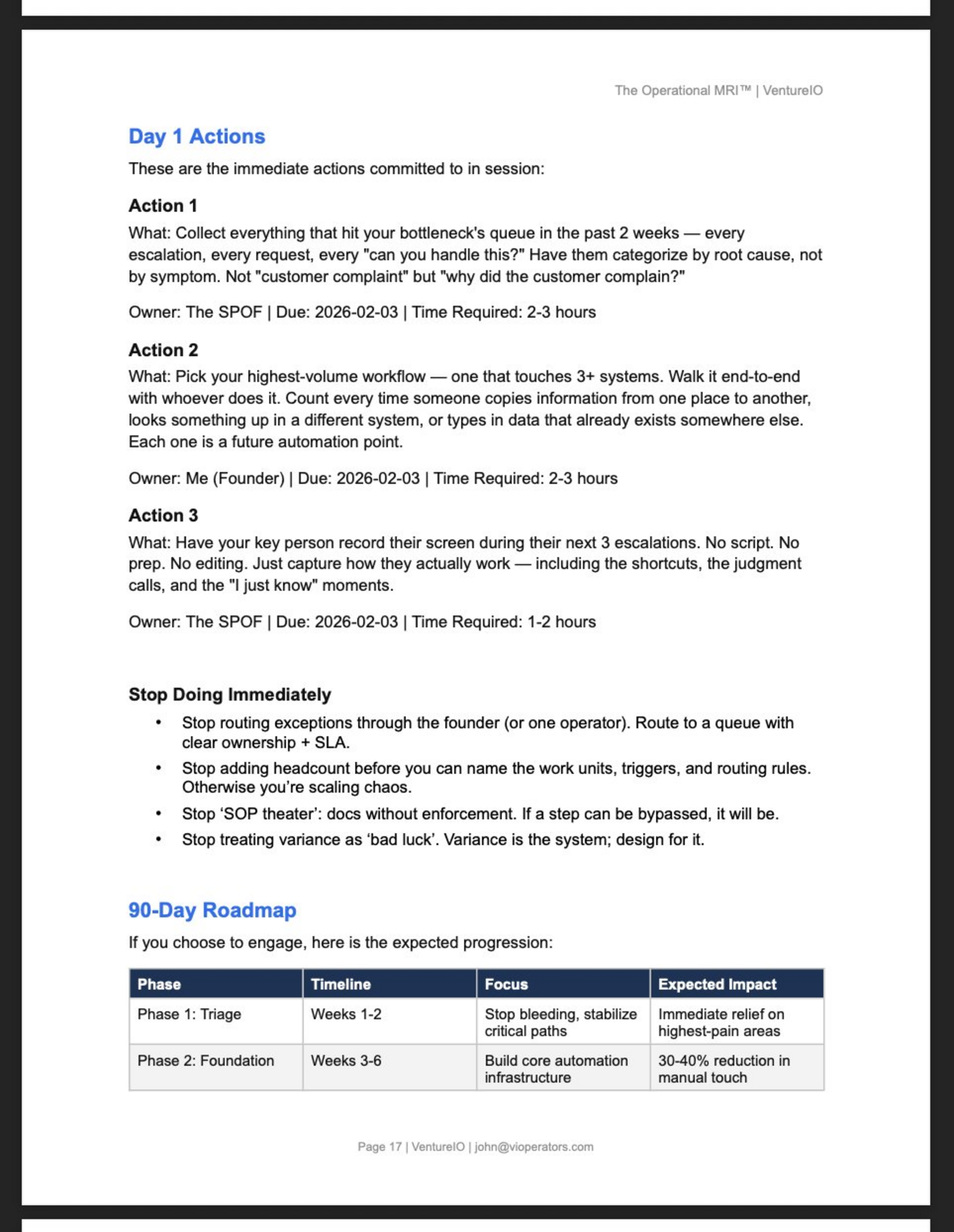
This isn't a dashboard. It's a written battle plan. Below are actual pages from a recent MRI—client name redacted, numbers real.
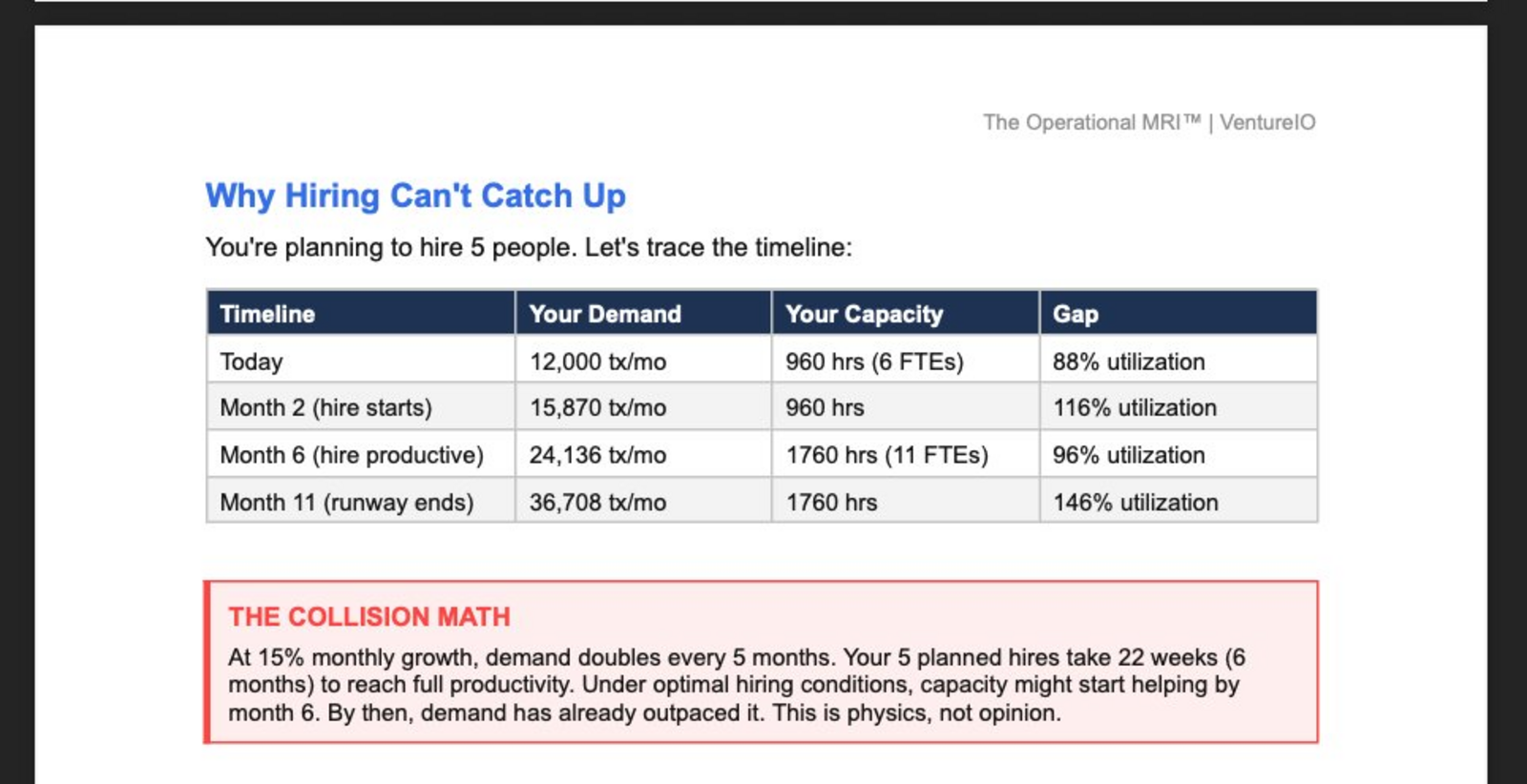
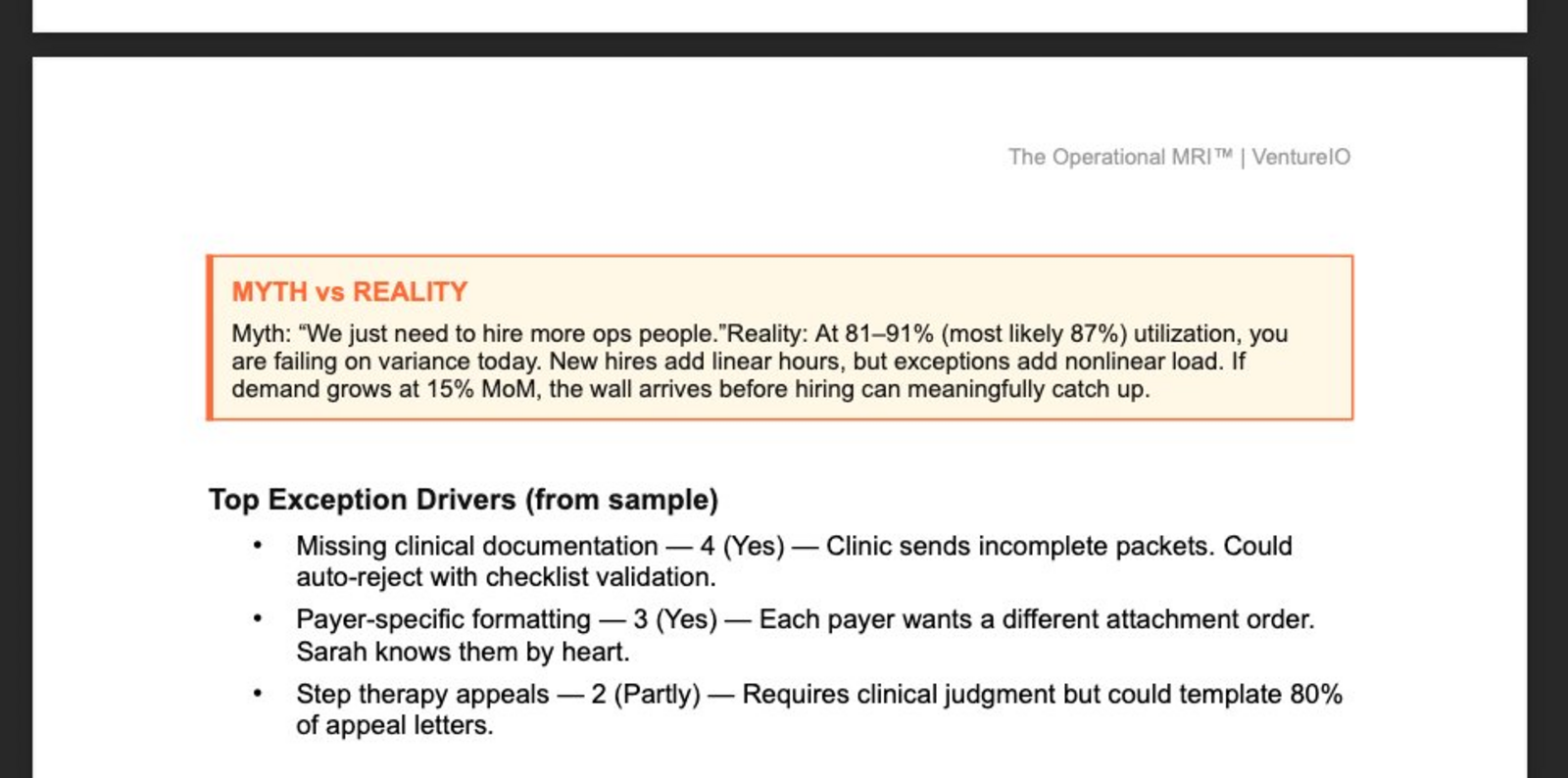
This is what founders don't see from the CEO seat.
The MRI shows the gap between your assumptions and reality—before you spend $2M finding out the hard way.
Reserve your MRI slot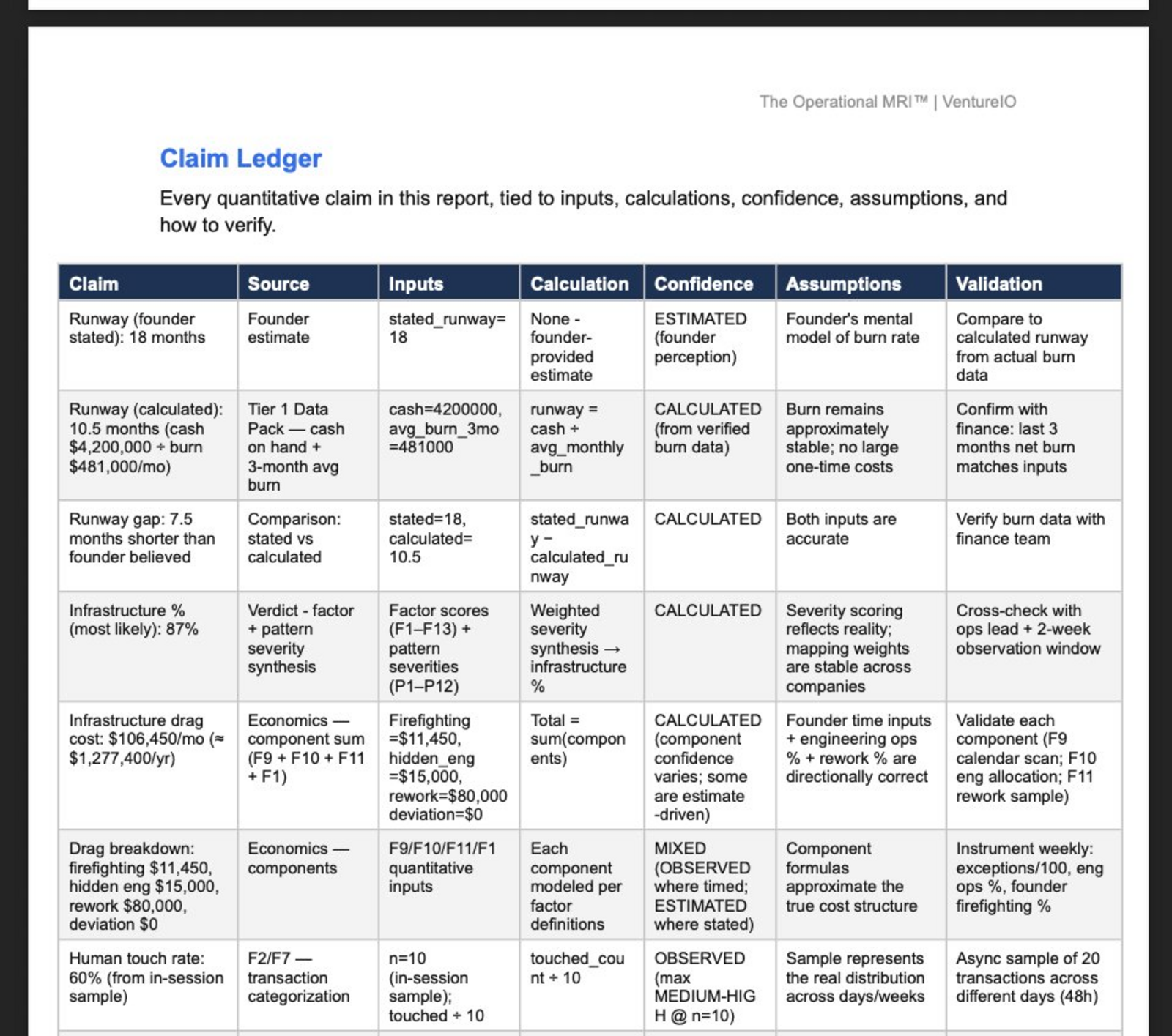
Tried AI too?
Most founders try hiring first. When that doesn't work, they try AI. When that doesn't work either, they find us.
Not because hiring and AI are wrong—but because both need something underneath them to work. We build that something. Then your hires perform and your AI delivers.
The Operational MRI now includes an AI Readiness Score—showing which AI investments are compounding your advantage and which are compounding your chaos.
See why hiring AND AI didn't fix it →What you get in 72 hours
Board Memo
A 3-page executive summary your board will actually read. The verdict, the cost, the fix sequence—written so you walk into your next board meeting with documented evidence, not vibes. This is what most founders are buying.
→ Walk into your board meeting prepared
Operator Appendix
The full diagnostic: patterns, collision math, evidence tables, and prioritized actions. When your VP Engineering and VP Product disagree about what's broken, this gives you data instead of opinions.
→ Settle internal debates with evidence
Claim Ledger
Every claim backed by evidence. What you said. What we found. What it means. Defensible, not vibes.
→ Keep yourself honest
How it works
Pre-work
10 minutes
Quick intake form. Basic numbers we'll validate live.
Session
90 minutes
Ground truth tests on your actual operations. No vibes. Just reality.
Delivery
72 hours
Board memo + operator appendix + claim ledger. Everything documented.
Review
15 minutes
Walk through findings. Answer questions. Clarify the path forward.
The objections (and why they're traps)
We've heard them all. Here's what we've learned.
"I don't have time for this right now."
That's the trap. There's always another fire to fight, another hire to make, another feature to ship. But the less time you have for this, the more you need it. Because the chaos consuming your calendar? That's what the MRI diagnoses. You're not too busy to do this—you're too busy because you haven't done this.
"We already hired. It's too late."
It's not too late—but it is more expensive every month you wait. The people you hired aren't the problem. They're running a system that doesn't exist yet. The MRI shows you what to build so those hires can actually help.
"$10K for a 90-minute session?"
The session is 90 minutes. The output is a board-ready memo, full diagnostic, and prioritized fix sequence you can execute immediately. Compare that to: (a) $150K for a hire who won't fix the root problem, (b) $50K+ for a consultant who delivers a deck you can't act on, or (c) $2M in burn figuring it out yourself. The math is straightforward.
"Can't we do this internally?"
You can. Most founders try. Here's what happens: your ops person is too close to the work to see the patterns. Your leadership team has cognitive biases about what's broken. And no one has time to build the diagnostic framework from scratch. The MRI works because it's external, systematic, and fast. You can't MRI yourself.
"We're not big enough yet."
If you're past product-market fit and planning to hire, you're big enough. The best time to build infrastructure is before the next growth spike—not after it exposes what's broken. The founders who wait until they're "big enough" are the ones who spend $2M learning what a $10K diagnostic would have shown.
"What if you find nothing wrong?"
Then you'll have documented evidence that your operations are ready to scale—something no founder has and every investor asks about. In practice, we've never seen this. Every post-PMF company has infrastructure gaps. The question is whether you find them now or let customers find them later.

Operator, not advisor.
I build the systems that replace headcount growth—so speed, quality, and margin scale together.
Omron Healthcare: The conventional playbook would have required hundreds of hires to scale Remote Patient Monitoring. I built infrastructure instead. A 10-person team generated +$5M in incremental profit over three consecutive years. NPS above 80. One of the largest RPM programs in America.
NHCPS: Founded, scaled, exited. $120K/month by day 90. $1.5M net profit year one. Served 200,000+ clinicians.
EO member at 23. MIT Entrepreneurial Masters Program at 24. NEJM Catalyst Council Member.
The Operational MRI
See why hiring didn't fix it—and what will.
No upsell trap: Most founders take the roadmap and execute with their own team. That's the point. The MRI is designed to be worth $10K on its own—not a sales pitch disguised as a diagnostic.
Stop hiring your way into a wall.
If you're already feeling the ceiling, the cheapest moment to fix it is before your next round of hires—and before the next growth spike exposes what's already broken.
Reserve your MRI slot ($5K deposit)Post-PMF founders only. Confidential. Fast. Actionable.
Prefer email? [email protected]